

Most industrial businesses have no shortage of real-time data in safety and operational environments. In reality, when it comes to avoiding incidents and injury, and improving efficiency, they are instead short of operational insight and the ability to take decisive and timely action. AI Vision for predictive maintenance and improving inventory accuracy provides that insight and can turn visibility into operational action.
Industrial businesses already have cameras across sites, collect machine signals, system alerts, and scanner data, and compile operational reports. Today, many have already started using AI Vision in live environments. Yet the same problems still show up in daily operations: avoidable incidents and delays, hazard risks surfacing and unexplained inventory gaps, maintenance uncertainty, and recurring waste. The path to informed decision-making, moving from insight to action at speed, is where blockages exist.
Deploying real-time computer vision can consistently lead to faster, better, and more impactful responses. It offers the opportunity to transform visibility into operational action. And that is what our two-part webinar series, Vision to Decision, is really about. In Part One, we explored the first five themes shaping successful AI Vision deployments. And in Part Two, we focused on the next five:
- Why robotics still creates friction
- Why inventory visibility often falls short of inventory truth
- Why predictive maintenance strategies need context
- How vision makes Lean performance visible, and
- What it takes to turn AI Vision into a true decision system
Across all five, the message is consistent: the biggest gains come from responding better rather than from seeing more. They come from closing the gap between vision and decision consistently, fast, and repeatably.
Coordination matters more than speed with AI Vision automation
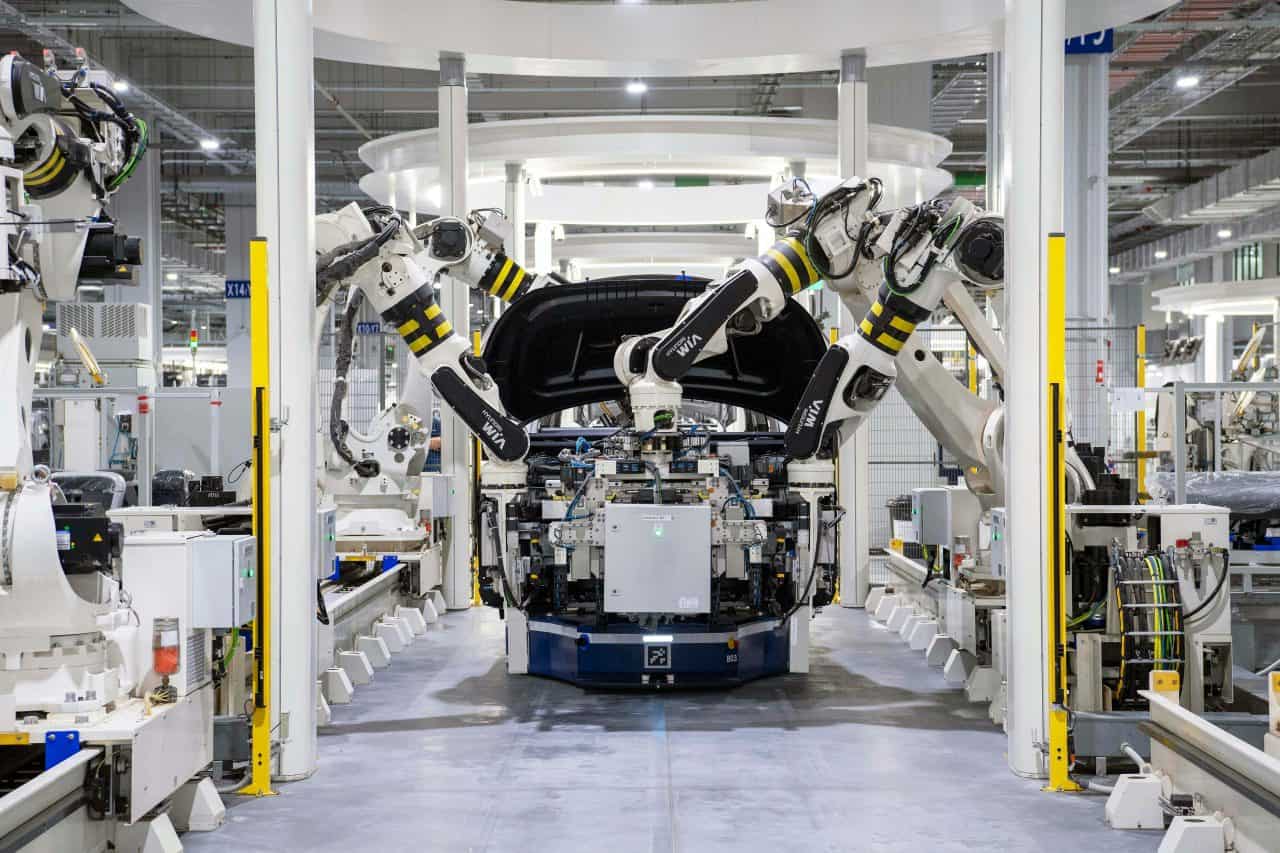
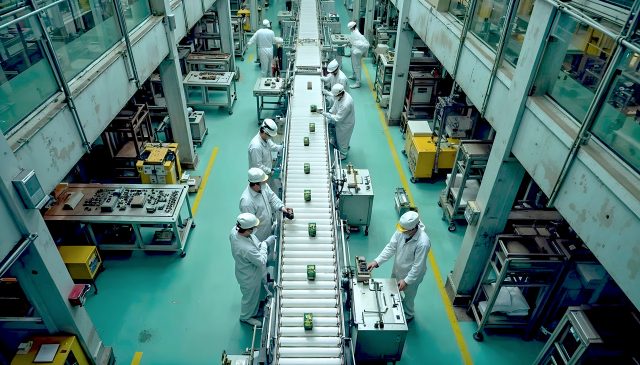
Automation continues to accelerate across manufacturing, warehousing, and logistics. Robots, cobots, and AMRs are now embedded in many critical workflows. In most cases, the equipment itself performs exactly as designed. So how can throughput, stability, and safety still miss expectations? We believe it is because the problem is coordination, rather than automation itself. It is
In real-world industrial operations, the friction shows up between systems. One station finishes faster than the next can absorb the work. Materials arrive too early. Buffers overflow. Congestion builds. Workers start improvising around queues and blockages to keep production moving. The robotic system may well be efficient locally, but without coordination, the wider operation becomes unstable.
This is where AI Vision for predictive maintenance and inventory accuracy adds considerable operational value.
Instead of focusing only on whether an asset is running, teams can observe how work moves across the whole system. They can see where bottlenecks form, where handoffs fail, and where mismatched pacing creates hidden risk.
This fundamentally re-shapes the improvement strategy. Teams stop asking how to make a single robot faster and instead address improving the overall flow. Often, the gains come from rebalancing work, adjusting layout, redesigning handoffs, or changing staffing and buffer logic, rather than more automation.
The result is stronger throughput, fewer stoppages, and safer workflows from the assets already in place.
Inventory accuracy, from visibility to truth
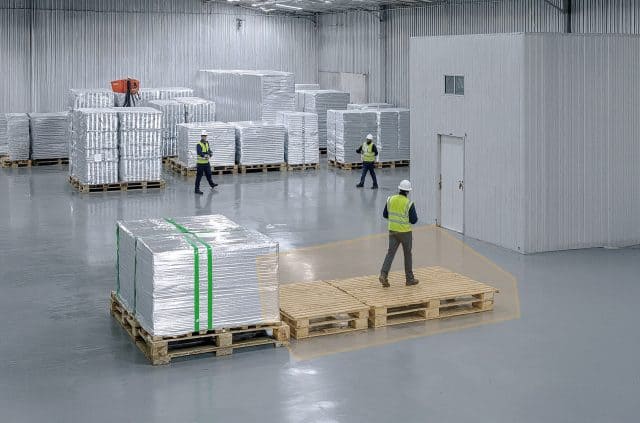
Most large organisations already have sophisticated inventory systems. They can track stock by SKU, location, age, movement, and value. At first glance, visibility looks strong.
Yet operations teams still face the same recurring issues. Stock is shown as available, but cannot be found. Damage appears late. Materials are technically in the right place in the system, but in reality, they may be blocked, misplaced, or unusable.
That is the gap between inventory visibility and inventory truth.
Vision AI automation helps close that gap by revealing what transactional systems cannot. It shows how materials are actually handled, where congestion leads to misplacement, which process steps create damage, and when storage design makes stock inaccessible. It captures what is happening physically, not just what was meant to happen in the system.
That matters because it shifts the response from reconciliation to root cause analysis.
Instead of treating inventory issues as counting human errors alone, teams can address the process conditions creating the inaccuracy. That may mean redesigning storage layouts, changing traffic flow, improving handling procedures, or adjusting peak-hour practices when pressure leads to rushed placement or missed scans.
This is where implementing AI Vision for inventory accuracy becomes especially valuable.
The goal is to create the operational conditions that make inventory accuracy sustainable, rather than simply counting more often. When that happens, shortages become less surprising, teams can reduce costly safety stocks, and production or fulfilment delays caused by missing materials start to fall away.
AI Vision automation and the context for alerts
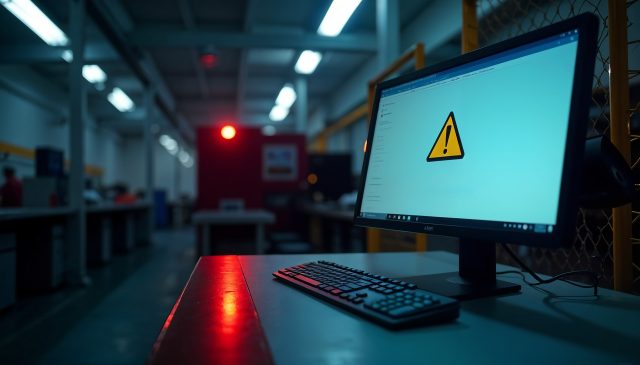
Predictive maintenance has been a strategic priority for years, but many teams still struggle with the same problem: a sensor raises an alert, yet the right decision remains unclear. Should maintenance intervene immediately? Or should they watch and wait? Perhaps shut the line down? Or else just ignore the signal as a normal variation?
Traditional sensor data is good at detecting anomalies. Vibration, temperature, current draw, and acoustic signals can all indicate that something is changing. What they can often struggle to provide is enough context to judge what that change actually means.
That is where AI Vision for predictive maintenance makes a meaningful difference.
By combining visual intelligence with sensor-based maintenance alerts, teams gain a clearer picture of what is happening around the asset. They can assess whether there is a visible leak, a loose component, a developing misalignment, unusual operating behaviour, or an environmental factor affecting performance.
That context improves decision quality. Teams can distinguish between false positives, temporary variation, and issues that require intervention before they escalate. They can act earlier when the risk is real, and avoid unnecessary disruption when it is not.
This improves how maintenance resources are used. Technicians spend less time chasing noise. Unplanned downtime falls. Equipment life can improve because issues are resolved before secondary damage occurs. Most importantly, maintenance teams gain confidence in their decisions.
A common misconception can be that AI Vision might replace sensors. In practice, it actually strengthens them by making signals explainable.
Making performance visible with AI Vision automation
Lean teams track performance closely. OEE, cycle time, downtime, and throughput are central to any serious continuous improvement effort. But those metrics still leave one crucial gap: they tell you what happened, but crucially not always why.
That is why AI Vision is increasingly valuable and essential in Lean performance, process optimisation, and even anomaly detection. It makes real work visible, rather than simply reported.
A surprising amount of waste goes unrecorded in conventional systems. Micro-stoppages may be too short to log. Operators may create informal workarounds when standard work does not fit the real condition. Motion waste, repeated handling, tool searching, waiting, and inconsistent execution often remain invisible unless someone happens to be watching in exactly the right place, and at exactly the right moment.
AI Vision radically changes that. It allows teams to see waste directly, measure how often it occurs, and connect it to process design rather than opinion. That makes root cause analysis more objective and more productive.
It also improves how teams verify change. After a layout update, standard work revision, or kaizen intervention, teams can see whether behaviour actually changed. Did the motion reduce? Did the bottleneck move? Did the new workflow stick? With AI Vision, teams benefit from invaluable insight that provides the opportunity to significantly improve performance.
That matters because continuous improvement only compounds when gains hold. With vision, drift becomes visible earlier. Teams can intervene before performance slips back to the old baseline.
The result is that Lean becomes faster, more collaborative, and more evidence-led. Less time is spent debating causes in a subjective manner. More time can then be spent improving the work itself.
Vision as a decision system, not just a dashboard
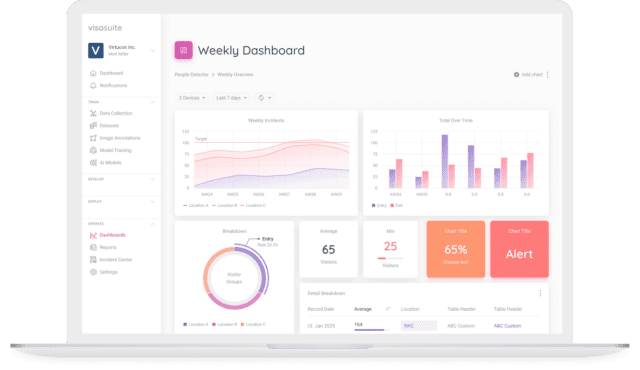
Many organisations have already reached the point where AI Vision can generate detections, reports, and dashboards. That creates operational visibility, which is useful, but it is not enough on its own. After all, a dashboard is still only a layer of observation, unless it drives meaningful and impactful action.
The organizations seeing the strongest outcomes are the ones turning AI Vision into a decision system. They connect detections to workflows, owners, and next steps so that action is triggered as part of the operating AI model, not left waiting for manual review.
This type of decision AI system can take many forms. A maintenance issue can move directly into the right workflow with supporting visual evidence. A recurring safety risk can trigger a review, retraining, or targeted intervention. A quality drift event can escalate to the line and engineering immediately. A logistics issue can prompt a routing change before congestion spreads. This is the real shift from passive reporting to active, real-world workflow automation.
When AI Vision is embedded in this way, response times shrink from hours to minutes, or minutes to seconds. Actions become more consistent across shifts and sites. People spend less time continuously monitoring dashboards and more time handling exceptions and improving processes.
This is also where value compounds, with continuous improvement. Once the loop is closed, each signal can strengthen future decisions. Knowledge becomes part of the workflow instead of living only in individual experience. That is when AI Vision stops being a tool you check and starts becoming a management layer that helps run industrial operations more effectively.
Inventory accuracy and predictive maintenance
Across robotics coordination, inventory management systems, supply chain management, predictive maintenance, Lean performance, and closed-loop workflows, one pattern consistently stands out.
Bottlenecks are rarely about whether the system can detect what matters. The harder challenge is execution: choosing the right use cases, wiring detections into the business, defining ownership, and scaling without adding complexity.
That is why the strongest deployments treat AI Vision as an essential part of the operating system. Not as a side project. Not as another dashboard. Not as a disconnected layer of insight.
AI Vision can be used to understand flow across automation, to expose the causes behind inventory inaccuracy, and to add context to predictive maintenance. Waste can become visible in continuous improvement and better decisions embedded directly into everyday operations.
That is the real meaning of ‘Vision to decision’. It is about creating faster, smarter, more repeatable responses at the point where operations succeed or fail, not collecting more signals.
Vision to decision: the measurable operating advantage
If your organisation already has cameras, systems, and data in place, the next question is simple: are you just seeing more, or are you deciding better? That is where the next phase of value sits.
It starts with the workflows where delays, uncertainty, waste, or risk are already costing you performance. When you identify where visual signals could trigger clearer action, you build from isolated visibility to a true decision system, one use case at a time.
This is how AI Vision moves from an interesting capability to a measurable operating advantage, and one that increasingly can no longer be ignored.