

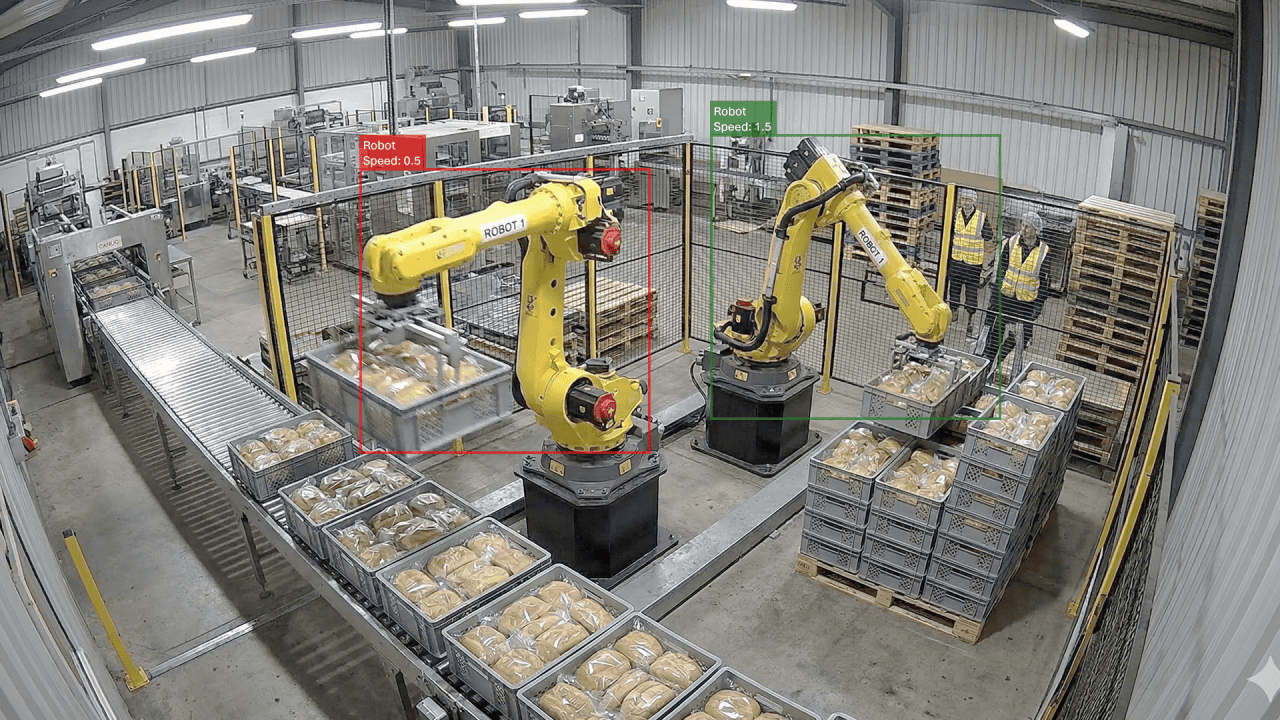
Food and beverage manufacturers operate in one of the most tightly controlled and margin-sensitive environments in industry. Compliance must hold across every shift, product quality has to be protected at each stage, and even small hygiene or process failures can lead to waste, downtime, or recalls.
Yet many of the controls used to reduce risks still depend on manual checks, periodic supervision, and paper-based verification. In fast-moving operations, that leaves gaps between what should happen and what actually happens on the floor. This is where AI Vision in food and beverage manufacturing has emerged as a viable, effective solution.
Why ROI compounds with AI Vision in food and beverage manufacturing
Food and beverage manufacturing operations run on tight tolerances. Variability is expensive, and it hides in plain sight:
- Safety checks are periodic snapshots, not continuous assurance
- CCTV helps investigations, but rarely prevents the next event
- Flow issues get debated in meetings instead of being measured in minutes
- Maintenance learns about problems when production calls, not when failure begins
Most sites already have cameras across warehouses, docks, corridors, and yard operations. That existing camera footprint makes it simple, practical, and efficient to turn video into consistent, measurable leading indicators that teams can act on shift by shift.
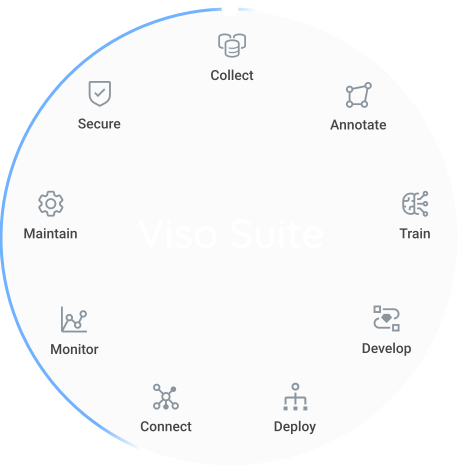
AI Vision helps close those gaps by verifying critical control points continuously. Using Viso Suite, manufacturers can deploy a wide range of applications and use cases, monitoring hygiene, PPE, zone access, and other operational risks in real time. The platform triggers event-based alerts and digital records that support action and audit readiness.
This is just one of several ways technology is future-proofing food and beverage manufacturing.
What AI Vision in food and beverage manufacturing changes
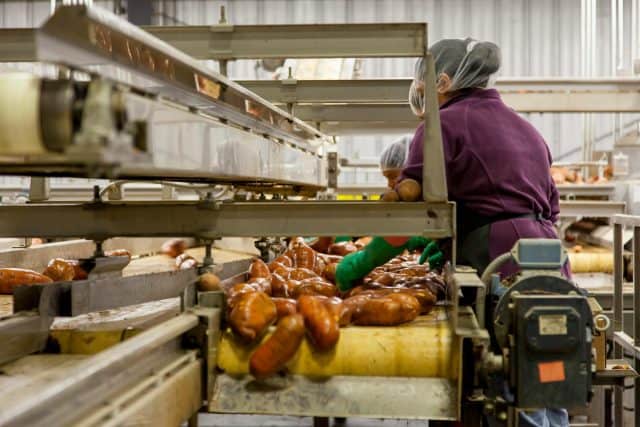
AI Vision in food and beverage manufacturing turns cameras into always-on sensors that help teams:
- See what is happening across critical zones (warehouse, yard, docks, production, utilities)
- Measure leading indicators such as near-misses, congestion, and abnormal conditions
- Act with real-time alerts, evidence, and trend reports that support continuous improvement
The objective is not surveillance. It is operational control with privacy-first design: masking options, policy-based retention, and anonymized event outputs that support governance, workforce trust, and cost savings.
More broadly, AI Vision is just one AI-powered technology driving transformation across Industry 4.0 for manufacturers, as outlined in a UiPath whitepaper, for example.
What scaling with AI Vision looks like in practice
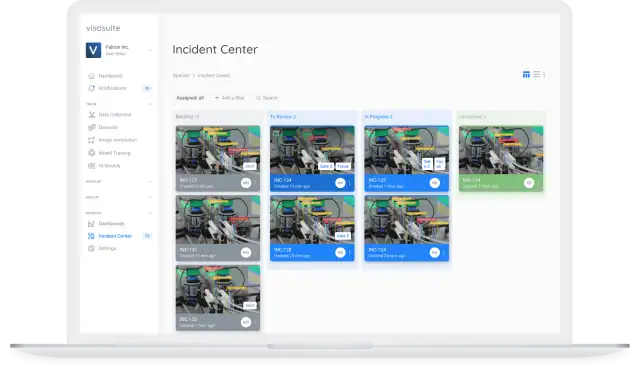
At one European site for a major global food and beverage manufacturer, vehicle and pedestrian interaction risk was a priority. Before AI Vision, the team had limited visibility into where near-misses clustered and what patterns drove them.
With limited warehouse coverage, the site detected a significant number of potential vehicle-related incidents within weeks, establishing a baseline dataset for targeted corrective action. The same site also faced meaningful annual damage costs linked to racks and doorways, which become addressable once events are detected consistently and hotspots are measurable.
This is the first compounding effect: one deployment creates baseline visibility through real-time insights, then makes the next use case faster to layer and implement, and subsequently easier to scale across multiple sites.
Layer use cases by zone and site
The simplest way to scale value is by layering use cases. Start in one high-impact zone, then add adjacent use cases that share cameras, teams, and response workflows
Warehouse safety
Start with “quick wins,” where risk and disruption intersect.
-
- Vehicle compliance: Detect near-misses, speeding, walkway segregation breaches, and impacts with racks or doorways. The outcome is faster behaviour correction, fewer repeat unsafe acts, and a measurable reduction in vehicle-related incidents.
- PPE compliance: Monitor eyewear, gloves, and footwear in defined zones and times. Here, the outcome is higher day-to-day compliance, fewer exposure risks, and better audit performance without turning safety into a policing exercise.
- Restricted areas: Flag entry into high-risk or hygiene-sensitive zones in real time. The outcome here is reduced unnecessary exposure, better control of critical areas, and stronger compliance evidence when audits happen.
Why it compounds: once camera connectivity, alert routing, and reporting are live, expanding coverage becomes repeatable. You are not reinventing the project with every new use case.
Yard and dock flow
Food and beverage sites are highly sensitive to flow variability. Yard congestion and buffer starvation create ripple effects across the line.
- Yard optimization: Track space occupancy, queue build-up, and dwell time patterns to reduce delays and prevent knock-on disruption.
- Buffer health: Detect empty buffer spaces that indicate blocked pallet flow and trigger action before the line is starved.
- Pallet quality: Identify damaged, leaning, or unstable loads early to reduce rework, claims, and safety risk.
Why it compounds: Safety gains reduce disruption. Flow gains protect OEE. Together, they reduce firefighting and stabilize production planning.
Predictive maintenance signals
Predictive maintenance is often framed as sensors on machines. In food and beverage, many failure modes are visible before they are measurable through traditional instrumentation.
- Leak and spill detection: In utilities and low-traffic areas to reduce contamination risk and avoid unplanned downtime
- Abnormal machine-state detection: Around packaging and end-of-line equipment to catch drift early
- Recurring intervention patterns: Correlate with jams and micro-stoppages, helping teams fix root causes instead of repeating resets
Why it compounds: When you already monitor safety and flow, you can connect preventative maintenance signals to the operational context. You do not just see that something failed. You see what led up to it, where it starts, and how often it repeats.
Fast-track stakeholder alignment
This checklist helps teams move faster from first deployment to broader implementation, easily and confidently layering additional use cases, and then rolling out to further sites, all as efficiently and painlessly as possible.
Privacy and workforce trust
- Are outputs anonymized and purpose-limited with clear governance?
- Can we mask areas, control retention, and limit access by role and site?
Security and integration
- Can it integrate with existing cameras or VMS and connect to operational systems via API?
- Does it meet enterprise InfoSec expectations, including auditability and controls?
Operational ownership
- Who receives alerts, and what is the response standard by shift?
- What metrics will be reviewed weekly, and what actions close the loop?
Step by step: best-practice rollout of AI Vision
Step 1: Kick off around the business objective
Define the operational issue to solve first, align stakeholders, and set a clear implementation plan around the outcome that matters most, whether that is safety, flow, compliance, or reducing downtime.
Step 2: Connect the environment
Bring the right cameras, zones, and data sources into scope. Focus on one high-impact area first so teams can establish baseline visibility and prove operational value quickly.
Step 3: Implement the first use case
Apply the vision model, business logic, and alerting workflow to a specific problem such as vehicle interaction risk, PPE compliance, or buffer disruption. Make sure alerts reach the right people with a clear response standard.
Step 4: Embed into day-to-day operations
Review events regularly, refine thresholds, and use the findings to support corrective actions on shift. This is where detections become operational change rather than passive reporting.
Step 5: Sign off and layer the next use case
Once the first deployment is delivering results, extend the same platform, governance model, and operating rhythm into the next adjacent use case. That is how value scales without restarting from scratch each time.
So, a typical, best-practice kick-off plan would be to:
- Align on objectives
- Connect cameras and access
- Configure the application
- Embed it into operating routines
- Use early results to shape the next scaling decision
Under the hood of the technology, briefly, check that the platform:
- Works with existing IP cameras and common VMS setups
- Supports privacy controls and edge-first processing where needed
- Produces anonymized event outputs and evidence for reporting
- Routes alerts to the right team in real time
- Integrates via APIs into EHS and operational workflows
- Scales from one zone to multi-site governance without re-architecture
The key takeaway for AI Vision in food and beverage manufacturing
A single use case can justify a first deployment. A layered program allows you to scale in the long term to streamline operations.
If you want compounding ROI, start with one warehouse risk, add one flow use case, then extend into implementing predictive maintenance programs. That is how AI Vision in food and beverage manufacturing moves from a point solution to a plant-wide operating advantage.