

Modern agentic AI systems do not perceive the world through a single model. Behind every production-ready vision AI that detects, reasons, and acts, there is a composed architecture built from three distinct layers: a perception model that captures the scene, a vision language model that interprets it, and an action layer that closes the loop.
Understanding how those layers fit together is the foundation of any serious agentic AI architecture. This article walks through each step by step, explains how they come together to form a working vision agent pipeline, and shows where edge computing enters the picture.
The Agentic Vision Stack at a High Level
At a high level, the agentic vision stack maps onto three roles that every capable AI agent must fill: see, understand, and act. A distinct layer handles each role, and each layer produces the input for the next.
- Perception layer: Processes raw visual input from cameras in real time and extracts structured information about the scene.
- VLM reasoning layer: Receives that structured information and interprets it using a vision language model capable of multi-step reasoning.
- Action layer: Takes the reasoning layer’s output and triggers a response in a connected system or downstream workflow.
The agentic vision stack is a composed system rather than a single model, with perception, reasoning, and action each responsible for a distinct function. As with all agentic systems, weakness in any one layer propagates through the entire pipeline.
This architecture is what separates computer vision that alerts from computer vision that acts. The stack is the mechanism that makes real-world agentic architectures possible, and understanding its structure is essential before deploying any production system.
Bring a new AI vision application to life.
Layer 1: Real-Time Perception and Vision AI
The perception layer is where vision AI begins. A perception model, typically a fast object detection model or a lightweight feature extractor, processes incoming video frames in real time. Detected objects, their spatial relationships, confidence scores, and temporal context are extracted and structured for the layer above. The result is a continuous stream of real-time data describing what is in front of each camera.
What makes this layer architecturally critical is that the quality of every downstream decision depends on it entirely. A perception model that misses objects or runs with unacceptable latency creates errors that no amount of reasoning can compensate for. The perception layer must be both accurate and fast, and those two requirements pull in opposite directions.
In most production-ready deployments, the perception layer runs at the edge on embedded systems, AI hardware accelerators, or edge devices close to the cameras themselves. This is a hard requirement: real-time inference at scale needs low-latency processing that a cloud round-trip cannot reliably guarantee.
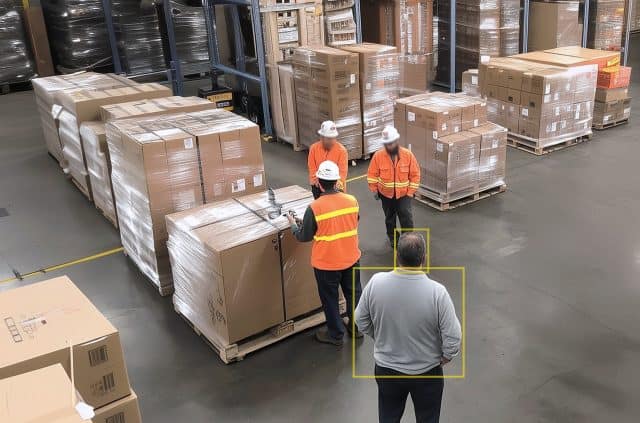
Running perception locally is also necessary when raw video data is sensitive and cannot be transmitted off-site. You can read more about the range of computer vision tasks the perception layer can be built to handle.
Layer 2: The Vision Language Model Reasoning Layer: How AI Models Think
The second layer is where a vision language model takes the perception layer’s output and makes sense of it. This is the reasoning core of agentic AI systems built on vision.
A vision language model combines the contextual reasoning capabilities of large language models (LLMs) with visual understanding. VLMs sit within the same family of generative AI models as LLMs, which is what gives the reasoning layer its interpretive flexibility. Rather than simply labeling what the perception model detected, the VLM interprets what those detections mean in the context of a specific task, environment, and operational history.

Is the scene normal or anomalous? What should happen next? How urgent is the response?
These are the questions the reasoning layer is designed to answer.
The context window is what makes multi-step reasoning possible here. The VLM can hold a structured representation of the current scene, relevant historical observations, and task-level instructions simultaneously. As a result, the reasoning layer can evaluate complex tasks, not just what was detected in the current frame, but how that fits into a broader pattern of events.
A VLM reasoning layer is what separates an AI agent that recognizes from one that understands. Recognition identifies that something is present. Understanding determines what it means and what should be done about it.
For context on how large vision models have expanded what is possible here, and on the broader shift toward large action models that integrate reasoning with behavior, see the linked guides. The VLM reasoning layer typically runs on a high-capability edge node or in the cloud, given the computational requirements of large-scale AI models relative to the narrow perception models in layer one.
Layer 3: Agent Workflows and Real-World Action
The action layer receives the VLM’s reasoned output and triggers a response in a real-world system. In a production-ready agentic architecture, that response is automated. Rather than producing an alert for a human to process later, the system completes the workflow.
What that looks like in practice varies by deployment, but common agent workflows at this layer include:
- Routing a contextual alert to the right person or system, with relevant evidence already attached
- Writing structured event records to external platforms such as EHS, WMS, or CMMS software
- Triggering AI-powered process automation downstream based on confirmed detections
- Escalating to human review when confidence thresholds require it

In larger deployments, a single agent is rarely working alone. Multi-agent workflows divide complex workflows across several specialized agents, each responsible for one part of the pipeline, which is how organizations scale beyond a single camera or a single site.
The action layer connects the AI agent to the systems an organization actually operates on. Without that integration, the agent can determine what should happen, but cannot make it happen, a ceiling that has limited traditional vision AI for years. The infrastructure to cross that ceiling now exists, and it is what makes agentic AI architectures deployable at scale in real-world environments.
Building a Multi-Step AI Agent: The Vision Agent Pipeline Step by Step
Each layer is meaningful on its own. What matters for implementation is how they compose into a complete, working vision agent pipeline. The sequence runs as follows, step by step:
- Camera input arrives at the edge-deployed perception model, which processes each frame in real time.
- Detected objects and scene metadata are extracted, structured, and passed to the reasoning layer.
- The VLM receives the structured perception output alongside task instructions and any relevant context held in the context window.
- The model reasons about the scene and produces a structured output: what is happening, what the appropriate agent response is, and with what urgency.
- The action layer receives that output and triggers the appropriate response in the connected downstream system.
- The outcome is logged and fed back into the system, closing the operational loop for continuous improvement.
This multi-step sequence is the core of any agentic vision architecture. It is also what turns individual AI models into powerful agents: AI agents built on this stack are capable of performing tasks in the real world from end to end, rather than stopping at detection.
Because each step depends on the accuracy of the previous one, production-ready deployments require evaluation at each layer independently as well as end-to-end. A system that performs well at detection but poorly at reasoning will still fail.

For a deeper look at how agentic computer vision applies this kind of architecture in operational settings, the linked guide covers real-world deployments in detail.
Research from Google DeepMind demonstrates how tightly perception and reasoning can be coupled in production systems: their RT-2 vision-language-action model shows that training on web-scale visual and language data transfers meaningfully into physical action, a direct validation of the vision agent pipeline approach. Similarly, the ReAct framework from Princeton and Google Brain provides foundational evidence for synergizing reasoning and action steps in language-based agents, a principle that applies directly to vision-based agents as well.
Where the Edge Fits in Agentic AI Architecture
Edge computing is a structural requirement of agentic AI architecture. The perception layer must run close to the camera for three reasons that are difficult to engineer around: latency, privacy, and bandwidth.
Video data is large. Sending raw streams to the cloud for perception introduces round-trip delays that break real-time requirements and consume bandwidth that may not be available in industrial or remote environments. Running the perception model at the edge eliminates that constraint. Local inference keeps visual data on-site, which matters whenever the environment involves sensitive subjects or regulated facilities.
For a full account of why edge AI is increasingly the deployment standard for vision systems, see the linked overview.

The VLM reasoning layer sits further up the compute stack. Most agentic architectures run it either on a capable edge server or in the cloud, depending on latency tolerances and data sensitivity requirements. The action layer is typically cloud-mediated, since its job is to interface with external business systems.
The resulting architecture is distributed by design: perception at the edge, reasoning as close to the edge as performance and data policy allow, and action connected to the broader enterprise. For vision-based agents that need to operate continuously at scale, the kind addressed by physical AI and queryable camera systems, this distributed model is simply how the stack works in practice.